Buy fincas.eu ?
We are moving the project
fincas.eu .
Are you interested in purchasing the domain
fincas.eu ?
domain@kv-gmbh.de · 0541-91531010
Buy fincas.eu ?
What exactly is the Peavey DPM Spectrum Bass?
The Peavey DPM Spectrum Bass is a digital bass guitar that was produced by Peavey Electronics in the 1990s. It featured a built-in digital signal processor (DSP) that allowed for a wide range of customizable sounds and effects. The bass also had MIDI capabilities, allowing it to be connected to other MIDI devices for even more sonic possibilities. Overall, the Peavey DPM Spectrum Bass was a versatile and innovative instrument for its time. **
How do I connect Peavey speakers to an amplifier?
To connect Peavey speakers to an amplifier, first, make sure the amplifier and speakers are turned off. Then, use speaker cables to connect the output terminals of the amplifier to the input terminals of the speakers. Ensure that the positive terminal of the amplifier is connected to the positive terminal of the speaker, and the same for the negative terminals. Once the connections are secure, turn on the amplifier and speakers and adjust the volume levels as needed. Always refer to the user manuals of the amplifier and speakers for specific instructions and safety precautions. **
Similar search terms for Peavey
Top-Angebote
Products related to Peavey:
-
Peavey Custom Shop EVH Wolfgang Custom South Korean Flag 2003 Electric Guitar Original - RefurbishedThis is a very special Peavey Custom Shop EVH Wolfgang electric guitar in Custom South Korean Flag finish. Made in the USA in 2003, this guitar came from the top end of Peavey's USA-made range, and was one of just two instruments made with the South Korean flag finish. Of course being a pioneering player & being known for outlandish & unique instruments, Eddie Van Halen developed the EVH signature with Ernie Ball Music Man in the early '90s, with the guitar being released in 1991, and was available until he moved to Peavey in 1995. The Peavey instrument was the first instrument named 'Wolfgang' & was a ground-up re-design of the EBMM instrument, first introduced at NAMM 1996. This was the instrument that really nailed what Ed was looking for - as can be seen by the fact that the EVH brand today still offers a Wolfgang which is almost identical to the Peavey iteration. Of course, a bolt on construction is employed, and comprises a Basswood body, Birdseye Maple neck and 22 fret Birdseye Maple fingerboard. A Peavey Licenced Floyd Rose double-locking tremolo system is installed, along with a set of Chrome Schaller tuning machines with Pearloid buttons. A pair of zebra-coil Peavey Custom Wound Passive Humbucking pickups are mounted directly onto the body, and are wired to a 3-way toggle switch, master volume & master tone controls. The Birdseye Maple neck plays exceptionally well, with the 'C' profile providing a smooth, responsive and precise playing experience across the register. The Satin finish to the rear of the neck ensures a smooth and supple feel in the hand whilst assisting with navigation of the 25.5" scale. The Birdseye Maple of the fingerboard is luxurious under the fingers, adding a real sense of opulence to the instrument. The 12"-16" radius is rounder in the lower register and flatter as you climb the neck, ensuring that the playing experience is tailored to the needs of the musician in all registers. The Jumbo frets make for smooth & solid string bending & vibrato techniques ensuring all your lead lines & guitar acrobatics are a breeze. The pair of Direct-Mount Peavey Custom Wound passive humbucking pickups installed in this guitar deliver thick and full-bodied tones, well suited to the hard rock, shred and guitar acrobatic style that Eddie was renowned for. The pickup selector is reversed, meaning that the bridge position is selected when the switch is up, just as Eddie preferred. The neck position is round and powerful, and retains plenty of clarity and precision for searing lead lines and solos. The bridge position is of course brighter and with a high output is powerful enough to drive your amp into a saturated distortion tone for rhythm parts and riffing. The controls are kept simple, with some extra refinement in the form of high and low friction pots with a treble bleed circuit. This means you can easily dial in your perfect tone right on the instrument.2730,00 £*Shipping: 0,00 £Secure redirect to the provider
-
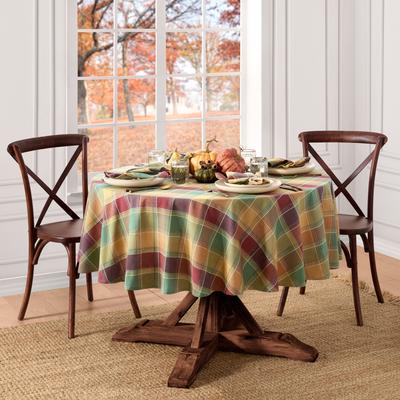
The Gray Barn Hallelujah Acres Window Curtain PanelLend a little something lovely to your home with this ruffled curtain panel. Your choice of light, gentle colors brings grace and splendor to your space, and the pom pom detail adds a dash of fun.44,49 $*Shipping: 0,00 $Secure redirect to the provider



-
How do I connect an external cabinet to the Peavey Bandit 112?
To connect an external cabinet to the Peavey Bandit 112, you will need to use the external speaker output on the back of the amplifier. First, make sure the amplifier is turned off and unplugged. Then, connect a speaker cable from the external speaker output on the amplifier to the input on the external cabinet. Make sure to match the impedance of the external cabinet with the amplifier's specifications to avoid damaging the equipment. Once the connection is made, you can turn on the amplifier and adjust the settings to your preference. **
-
Why does the Catholic Church keep its land properties?
The Catholic Church keeps its land properties for a variety of reasons. One reason is to provide a physical presence in communities where they can offer services such as schools, hospitals, and social programs. Additionally, owning land allows the Church to maintain historical and cultural sites that are important to the faith. Finally, land ownership can also provide a source of income through renting or leasing properties, which can help fund the Church's operations and charitable activities. **
-
How can one merge properties and land parcels together?
One way to merge properties and land parcels together is through a process called property consolidation. This involves legally combining multiple parcels of land into a single, larger parcel. This can be done by filing a request with the local government or planning department, providing documentation such as surveys and deeds, and paying any required fees. It is important to consult with a real estate attorney or land use professional to ensure the process is done correctly and in compliance with local regulations. **
-
How can one merge properties and parcels of land?
One way to merge properties and parcels of land is through a process called lot consolidation or lot merger. This typically involves combining adjacent parcels of land that are owned by the same individual or entity into a single, larger parcel. The process usually requires approval from local zoning authorities and may involve submitting a formal application, survey, and legal descriptions of the properties involved. Once approved, the new, merged parcel will have a single tax assessment and legal description. **

Were the regional estates represented in the Imperial Estates?
Yes, the regional estates were represented in the Imperial Estates of the Holy Roman Empire. The Imperial Estates were made up of different territories and regions, each of which was represented by its own ruler or representative. These regional estates included the princes, bishops, and cities of the empire, and they played a significant role in the governance and decision-making of the Holy Roman Empire. The regional estates had a voice in the Imperial Diet, where important matters of the empire were discussed and decided upon. **
How do you convert hectares to acres?
To convert hectares to acres, you can use the conversion factor of 1 hectare being equal to 2.47105 acres. So, to convert hectares to acres, you would multiply the number of hectares by 2.47105. For example, if you have 5 hectares, you would multiply 5 by 2.47105 to get 12.35525 acres. **
Top-Angebote
Products related to Peavey:
-
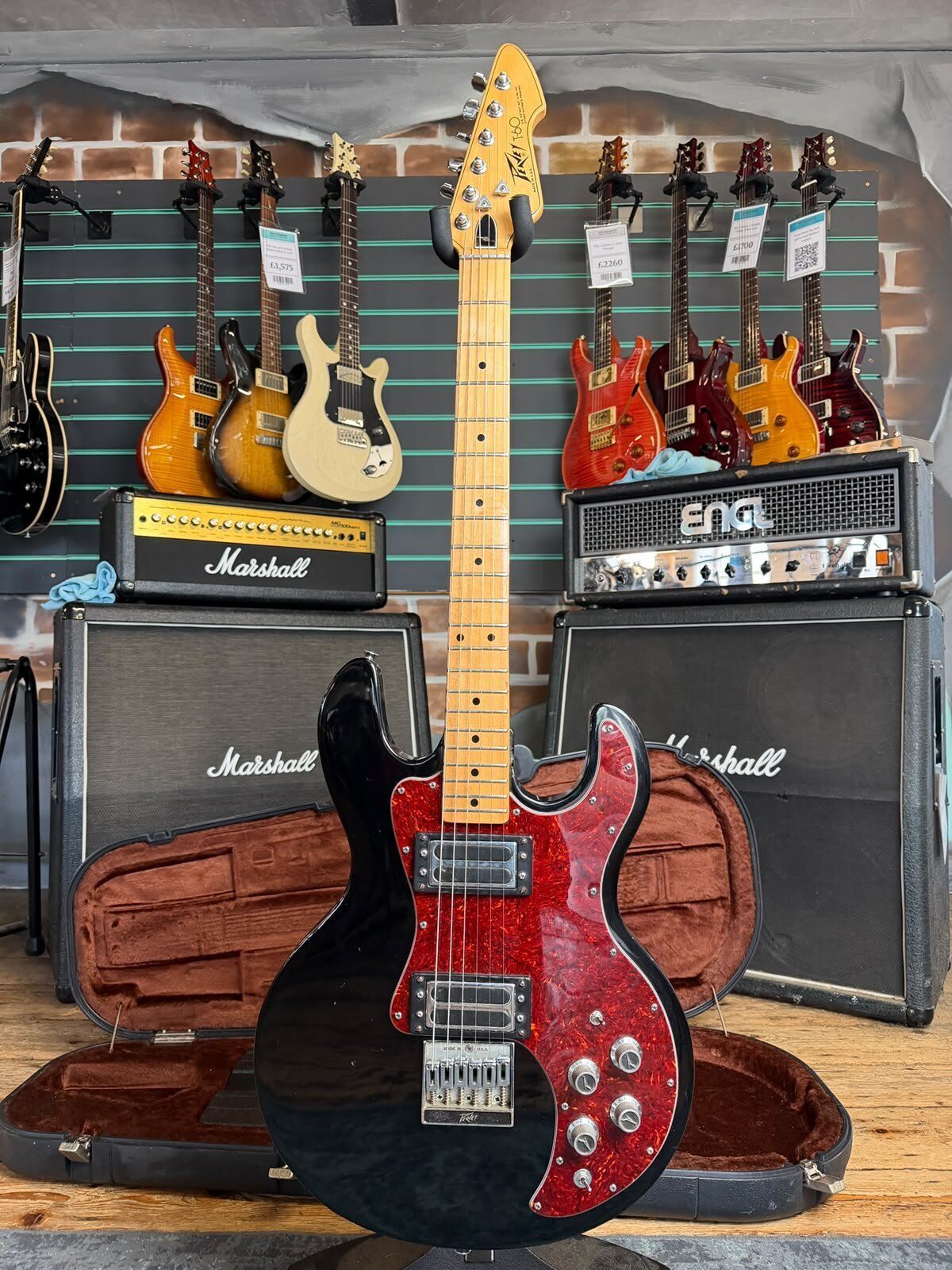
Peavey T-60 Black 1980 Electric Guitar black - RefurbishedThis is a Peavey T-60 Electric Guitar in Black finish. Made in the USA in 1980, this guitar consists of an Ash body, a Maple neck, and a 21-fret Maple fingerboard. Other appointments include a Die-cast integrated bridge/tailpiece, Die-cast Sealed Peavey tuners, and a set of Red Rhodes-Designed Toaster-Top Split-Coil Blade Humbuckers. These pickups are wired to two volume controls, two tone controls (with coil-split roll-off), a phase switch, and a three-way pickup selector. The gloss finish to the rear is pleasant to the touch, and offers a smooth and tactile surface for the hand to rest. The Maple fingerboard adds a touch of smoothness to the playing experience, and with its 12" radius provides a nicely flat & consistent playing surface right the way up the register. The generous double cutaways enhance access to the upper frets, whilst the slightly extended upper horn helps to balance the guitar on a strap. The pair of Peavey Red Rhodes-Designed Toaster-Top Split-Coil Blade humbucking pickups in this guitar deliver thick and throaty tone, well suited to a wide range of genres. The neck pickup is warm and round, with a robust low end, driving mids and a sparkling treble response that captures the attack of your playing excellently. The bridge pickup is brighter, and helps to push your sound forward in the mix. The control layout offers some incredibly unique tonal variations when utilising the phase switch, and the coil-split roll-off design with the tone knobs. Rolling the tone knob past 7 down to 10 splits the humbucker coils into single-coil operation; 7 down to 0 acts as a standard tone roll-off.800,00 £*Shipping: 0,00 £Secure redirect to the provider
-
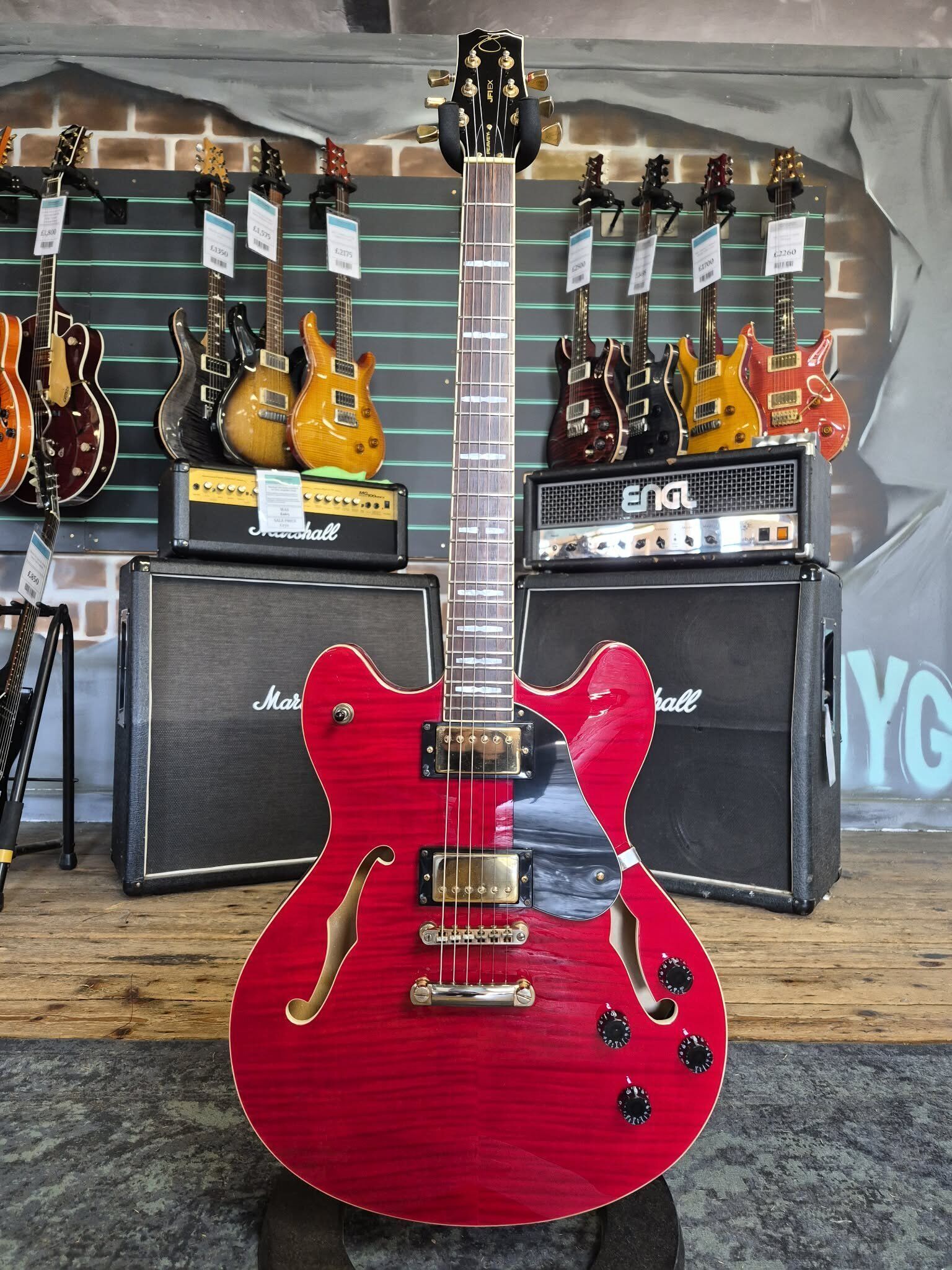
Peavey JF1EX Transparent Red Semi-Hollow Electric Guitar red - RefurbishedThis is a Peavey JF1EX Semi-Hollow electric guitar in Transparent Red finish. Made in China, this guitar features a set-neck construction comprising a Laminated Maple body with a Figured Maple top and a Maple centre block, a Hard Rock Maple neck and 22 Medium Jumbo fret Rosewood fingerboard. The guitar is equipped with Gold hardware including a Tune-O-Matic bridge and StopBar tailpiece, along with a set of Sealed tuning machines. A pair of Peavey USA Design Ceramic humbucking pickups are installed, these are wired to a 3-way toggle switch and independent volume & tone controls. The Hard Rock Maple neck plays well, with a profile resembling a ‘D’ feeling comfortable in the hand, offering easy fretting in any register. The Gloss finish to the rear feels pleasant to the touch and aids easy transitions up and down the neck, whilst the 12” Rosewood fingerboard and Medium Jumbo frets provide a robust playing experience that feels rock solid under the fingers, enhancing string bending and vibrato techniques. The semi-hollow construction makes this guitar easy on the shoulders on long gigs, and the smooth lines of the body ensure that this is a comfortable guitar to play in either standing or seated positions. The semi-hollow construction of this guitar means that it resonates and sustains very well thanks to the Maple centre block. It produces an airy tone with an unpronounced yet well defined low end, detailed upper midrange and sparkly high frequencies. With clean settings the Peavey USA Design Ceramic humbucker in the neck produces a round and smooth tone, perfectly suited to jazz. When driving the amp, the tone is rich and crunchy, lending itself well to blues. A versatile package of tones, especially with the individual volume and tone controls for each pickup.280,00 £*Shipping: 0,00 £Secure redirect to the provider
-
Peavey Custom Shop EVH Wolfgang Custom South Korean Flag 2003 Electric Guitar Original - RefurbishedThis is a very special Peavey Custom Shop EVH Wolfgang electric guitar in Custom South Korean Flag finish. Made in the USA in 2003, this guitar came from the top end of Peavey's USA-made range, and was one of just two instruments made with the South Korean flag finish. Of course being a pioneering player & being known for outlandish & unique instruments, Eddie Van Halen developed the EVH signature with Ernie Ball Music Man in the early '90s, with the guitar being released in 1991, and was available until he moved to Peavey in 1995. The Peavey instrument was the first instrument named 'Wolfgang' & was a ground-up re-design of the EBMM instrument, first introduced at NAMM 1996. This was the instrument that really nailed what Ed was looking for - as can be seen by the fact that the EVH brand today still offers a Wolfgang which is almost identical to the Peavey iteration. Of course, a bolt on construction is employed, and comprises a Basswood body, Birdseye Maple neck and 22 fret Birdseye Maple fingerboard. A Peavey Licenced Floyd Rose double-locking tremolo system is installed, along with a set of Chrome Schaller tuning machines with Pearloid buttons. A pair of zebra-coil Peavey Custom Wound Passive Humbucking pickups are mounted directly onto the body, and are wired to a 3-way toggle switch, master volume & master tone controls. The Birdseye Maple neck plays exceptionally well, with the 'C' profile providing a smooth, responsive and precise playing experience across the register. The Satin finish to the rear of the neck ensures a smooth and supple feel in the hand whilst assisting with navigation of the 25.5" scale. The Birdseye Maple of the fingerboard is luxurious under the fingers, adding a real sense of opulence to the instrument. The 12"-16" radius is rounder in the lower register and flatter as you climb the neck, ensuring that the playing experience is tailored to the needs of the musician in all registers. The Jumbo frets make for smooth & solid string bending & vibrato techniques ensuring all your lead lines & guitar acrobatics are a breeze. The pair of Direct-Mount Peavey Custom Wound passive humbucking pickups installed in this guitar deliver thick and full-bodied tones, well suited to the hard rock, shred and guitar acrobatic style that Eddie was renowned for. The pickup selector is reversed, meaning that the bridge position is selected when the switch is up, just as Eddie preferred. The neck position is round and powerful, and retains plenty of clarity and precision for searing lead lines and solos. The bridge position is of course brighter and with a high output is powerful enough to drive your amp into a saturated distortion tone for rhythm parts and riffing. The controls are kept simple, with some extra refinement in the form of high and low friction pots with a treble bleed circuit. This means you can easily dial in your perfect tone right on the instrument.2730,00 £*Shipping: 0,00 £Secure redirect to the provider
-
What exactly is the Peavey DPM Spectrum Bass?
The Peavey DPM Spectrum Bass is a digital bass guitar that was produced by Peavey Electronics in the 1990s. It featured a built-in digital signal processor (DSP) that allowed for a wide range of customizable sounds and effects. The bass also had MIDI capabilities, allowing it to be connected to other MIDI devices for even more sonic possibilities. Overall, the Peavey DPM Spectrum Bass was a versatile and innovative instrument for its time. **
-
How do I connect Peavey speakers to an amplifier?
To connect Peavey speakers to an amplifier, first, make sure the amplifier and speakers are turned off. Then, use speaker cables to connect the output terminals of the amplifier to the input terminals of the speakers. Ensure that the positive terminal of the amplifier is connected to the positive terminal of the speaker, and the same for the negative terminals. Once the connections are secure, turn on the amplifier and speakers and adjust the volume levels as needed. Always refer to the user manuals of the amplifier and speakers for specific instructions and safety precautions. **
-
How do I connect an external cabinet to the Peavey Bandit 112?
To connect an external cabinet to the Peavey Bandit 112, you will need to use the external speaker output on the back of the amplifier. First, make sure the amplifier is turned off and unplugged. Then, connect a speaker cable from the external speaker output on the amplifier to the input on the external cabinet. Make sure to match the impedance of the external cabinet with the amplifier's specifications to avoid damaging the equipment. Once the connection is made, you can turn on the amplifier and adjust the settings to your preference. **
-
Why does the Catholic Church keep its land properties?
The Catholic Church keeps its land properties for a variety of reasons. One reason is to provide a physical presence in communities where they can offer services such as schools, hospitals, and social programs. Additionally, owning land allows the Church to maintain historical and cultural sites that are important to the faith. Finally, land ownership can also provide a source of income through renting or leasing properties, which can help fund the Church's operations and charitable activities. **
Similar search terms for Peavey
-
The Gray Barn Hallelujah Acres Window Curtain PanelLend a little something lovely to your home with this ruffled curtain panel. Your choice of light, gentle colors brings grace and splendor to your space, and the pom pom detail adds a dash of fun.44,49 $*Shipping: 0,00 $Secure redirect to the provider
-
How can one merge properties and land parcels together?
One way to merge properties and land parcels together is through a process called property consolidation. This involves legally combining multiple parcels of land into a single, larger parcel. This can be done by filing a request with the local government or planning department, providing documentation such as surveys and deeds, and paying any required fees. It is important to consult with a real estate attorney or land use professional to ensure the process is done correctly and in compliance with local regulations. **
-
How can one merge properties and parcels of land?
One way to merge properties and parcels of land is through a process called lot consolidation or lot merger. This typically involves combining adjacent parcels of land that are owned by the same individual or entity into a single, larger parcel. The process usually requires approval from local zoning authorities and may involve submitting a formal application, survey, and legal descriptions of the properties involved. Once approved, the new, merged parcel will have a single tax assessment and legal description. **
-
Were the regional estates represented in the Imperial Estates?
Yes, the regional estates were represented in the Imperial Estates of the Holy Roman Empire. The Imperial Estates were made up of different territories and regions, each of which was represented by its own ruler or representative. These regional estates included the princes, bishops, and cities of the empire, and they played a significant role in the governance and decision-making of the Holy Roman Empire. The regional estates had a voice in the Imperial Diet, where important matters of the empire were discussed and decided upon. **
-
How do you convert hectares to acres?
To convert hectares to acres, you can use the conversion factor of 1 hectare being equal to 2.47105 acres. So, to convert hectares to acres, you would multiply the number of hectares by 2.47105. For example, if you have 5 hectares, you would multiply 5 by 2.47105 to get 12.35525 acres. **
* All prices are inclusive of VAT and, if applicable, plus shipping costs. The offer information is based on the details provided by the respective shop and is updated through automated processes. Real-time updates do not occur, so deviations can occur in individual cases. ** Note: Parts of this content were created by AI.